
❝
Business mentions
Your business is named in an AI-assisted answer.
Observed in the responseUnderstand where your business is visible in AI-assisted search—and where buyers cannot find enough information to evaluate you.
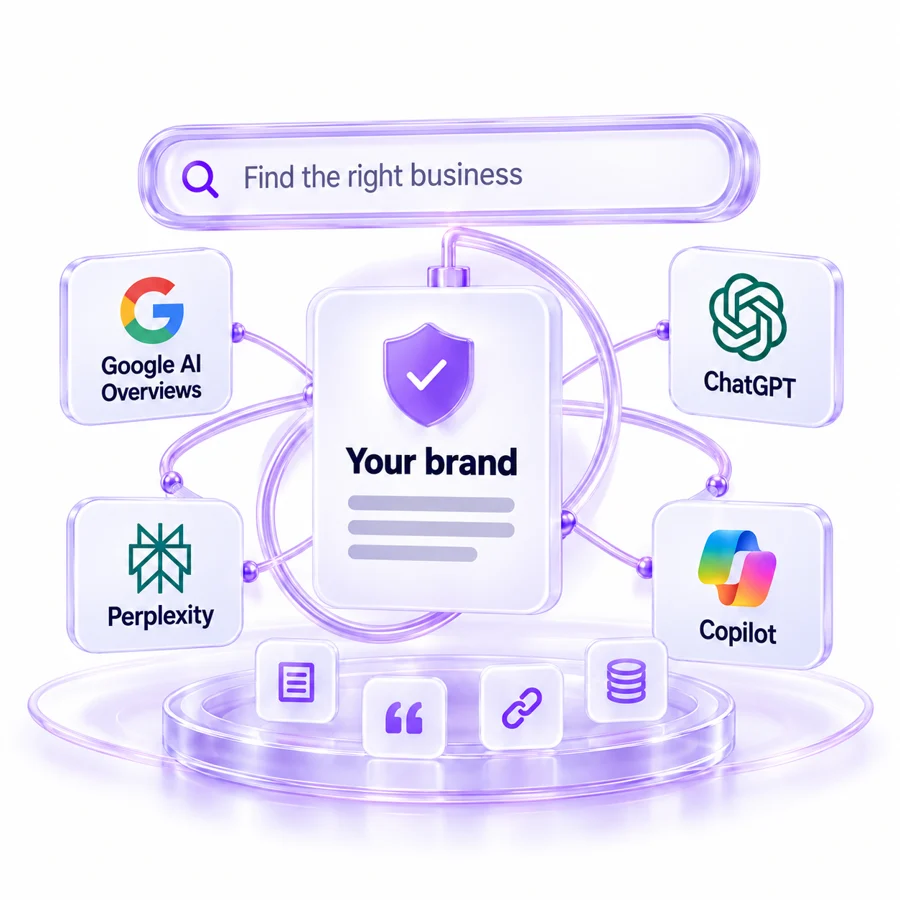
MTI Tech reviews your priority questions, relevant public pages and observable citations, then prepares an evidence-led improvement plan. The review distinguishes business mentions, linked sources, search impressions and referral activity rather than combining them into an unexplained visibility score.

A single number hides what actually happened. The review keeps each signal separate so you can see what it means and where it came from.
Your business is named in an AI-assisted answer.
Observed in the responseA page is shown as a source a reader can open.
Observed citationYour pages appear in search surfaces you can measure.
Search console dataVisitors actually arrive from AI-assisted platforms.
Your analyticsEvery step produces something you can inspect and repeat later.
Agree the priority questions your buyers actually ask. The set stays fixed so repeat checks can be compared.
Question setRecord the platform, the date and what the response showed. Repeat the checks rather than relying on one answer.
Observation logMap which of your public pages—and which outside sources—are cited or missing for each question.
Coverage mapConfirm priority pages are reachable by appropriate public crawlers and that indexing and snippet controls match your goal.
Access checklistPresent each finding with the observation behind it, followed by a prioritised improvement plan.
Evidence reportState plainly what the data can show, what it cannot, and how much it may vary.
Limitations noteMuch of a business's best evidence lives in proposals, sales calls and inboxes. If it isn't public, buyers—and AI-assisted search—can't use it.
Findings sit next to the observations behind them, so every recommendation can be traced back to what was actually seen.
Fixed set, agreed before the first check.
Results vary between checks; both are retained.
Coverage shows where to improve, not a ranking.
Prioritised by buyer impact and effort.
Being clear about limits is part of the method. These notes appear in every report.
AI-assisted answers can change with date, location, account and phrasing.
One observation is not a ranking, and one favourable answer is not market leadership.
A mention is not a citation, a citation is not a visit, and a visit is not a sale.
We cannot control or guarantee what an AI system says about your business.
The baseline is the assessment: a fixed question set, observations, source coverage, access checks and an evidence report. AEO is the ongoing work to improve content and evidence based on what the baseline finds.
No. Mentions, linked sources, search impressions and referral activity are reported separately, because combining them hides what actually happened.
Repeat checks are only comparable when the questions stay the same. The set can be revised deliberately, with the change noted in the report.
No. We can review access, content and observable visibility and recommend improvements. We cannot control or guarantee what an AI system says.
Your target customers, priority services, the questions buyers ask your team, and access to search and analytics data where available.
Bring your priority services and the questions customers ask. We’ll return a baseline you can repeat and improve against.