The Technical SEO Checklist: 5 Hidden Errors Killing Your Rankings
If you’ve been investing hours into creating high-quality content but still find your website buried in search results, you’re not alone. Many businesses focus on content and backlinks, yet neglect the technical side of SEO, the hidden errors that can silently kill your rankings. This is where Technical SEO comes in, a critical but often overlooked aspect of digital marketing.
Even great content needs a strong foundation to be visible online. Hidden technical issues like poor crawlability, missing HTTPS, or broken XML sitemaps can prevent search engines from properly indexing your website. In this blog, we’ll take a deep dive into the five hidden technical errors that could be killing your rankings and show you how professional SEO Optimization Services can help fix them.
What is Technical SEO and Why It Matters
Technical SEO refers to the optimization of your website’s infrastructure to ensure search engines can crawl, index, and rank your pages efficiently. While content SEO focuses on keywords, backlinks, and user engagement, technical SEO ensures that your website is search-engine friendly at its core.
Think of technical SEO as the foundation of a house. If your foundation isn’t solid, even the coolest-looking interior (your content) will eventually fall apart.. Issues like slow site speed, insecure connections, and inaccessible pages can prevent Google from understanding your site, limiting your organic visibility.
By leveraging professional SEO Optimization Services, businesses can identify and resolve these hidden problems, giving their content the best chance to rank.
A website’s performance is not only about content quality or keyword targeting, it’s also about how efficiently search engines can interact with it. Many hidden technical issues silently affect rankings, such as duplicate content, improper redirects, missing canonical tags, or inefficient site architecture. These problems can confuse crawlers, dilute link equity, and prevent search engines from understanding which pages are most important.
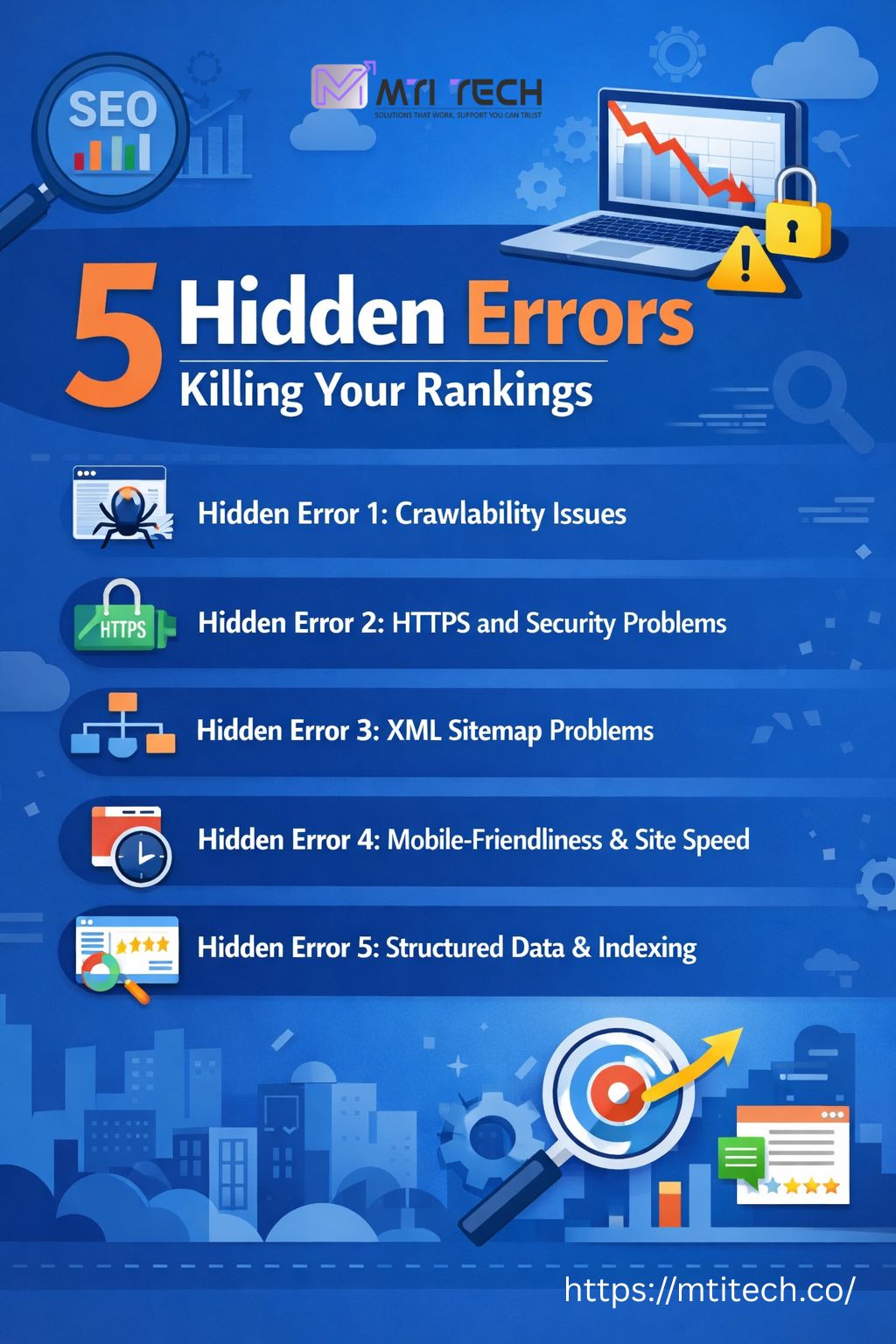
5 Hidden Errors Killing Your Rankings
Hidden Error 1: Crawlability Issues
Crawlability refers to how easily search engines can navigate and read your website. Google employs crawlers, also known as bots, to index content throughout the web. If crawlers can’t reach your pages, your content won’t appear in search results no matter how good it is.
Common crawlability problems include:
- Broken internal links – Links pointing to nonexistent pages confuse crawlers.
- Blocked pages in robots.txt – Incorrect instructions can hide pages from Google.
- Orphan pages – Pages with no internal links leading to them remain undiscovered.
How to fix it:
Conduct a full crawlability audit to detect unreachable pages, broken links, and robots.txt issues. Ensure every important page is accessible via internal linking, and submit an updated XML sitemap to search engines.
Professional SEO Optimization Services start by performing these audits, ensuring your entire website is visible to search engines and that no valuable content is left undiscovered.
Hidden Error 2: HTTPS and Security Problems
Security is no longer optional. Google considers HTTPS a ranking factor, and users trust sites that display a secure connection. Websites without HTTPS or with mixed content issues risk losing both rankings and credibility.
Common HTTPS problems include:
- Expired SSL certificates
- Mixed content (secure and non-secure elements on a page)
- Incorrect redirections from HTTP to HTTPS
Impact on rankings:
Websites without proper HTTPS are less likely to rank well. In addition, browsers flag insecure sites, which can deter visitors.
Solution:
Upgrade your website to HTTPS and resolve mixed content issues. Regularly monitor SSL certificate expiration dates to avoid downtime.
Implementing HTTPS correctly is a standard part of SEO Optimization Services, ensuring your website remains secure, trustworthy, and optimized for search engines.
Hidden Error 3: XML Sitemap Problems
An XML sitemap is essentially a roadmap for search engines, guiding them to all your important pages. If your sitemap is broken, outdated, or improperly formatted, Google may fail to index key pages.
Common sitemap issues:
- Missing or outdated URLs
Your XML sitemap should list all the important pages on your website. If some URLs are missing or outdated (no longer exist or moved), search engines may miss indexing important content. - Incorrect formatting
XML sitemaps must follow a specific code structure. Incorrect formatting, like missing tags or wrong syntax, can make the sitemap unreadable by search engines. - Pages blocked in robots.txt included in the sitemap
Your sitemap should only include pages you want search engines to index. Sometimes, pages that are blocked in robots.txt (instructions telling search engines not to crawl certain pages) are mistakenly included in the sitemap.
Solution:
Generate a clean, up-to-date XML sitemap and submit it to Google Search Console. Include only important pages and ensure the sitemap updates automatically with new content.
For many businesses, proper sitemap management is a critical task performed by SEO Optimization Services, which ensures that every valuable page is indexed and ranked appropriately.
Hidden Error 4: Mobile-Friendliness and Site Speed
In 2025, Google’s mobile-first indexing means that your mobile site version determines your rankings. A slow-loading or non-responsive website can drastically hurt your visibility and user experience.
Common issues:
- Non-responsive design on mobile devices
A non-responsive website doesn’t automatically adjust to fit different screen sizes, such as smartphones or tablets. - Large images or unoptimized media
Images and videos that are too large can slow down your website significantly. - Slow server response times
This refers to the amount of time it takes for your server to respond to a visitor’s request and start loading the page.
Solution:
- Implement responsive design for all devices
Use responsive design that adapts layouts, fonts, and images to any screen size. Test your website on multiple devices using tools like Google’s Mobile-Friendly Test. - Compress images and use lazy loading
Compress images using tools like TinyPNG or ShortPixel. Use modern formats like WebP instead of JPG or PNG. Implement lazy loading, so images load only when a user scrolls down the page. - Optimize server performance and caching
Upgrade to a faster hosting plan or server. Use caching plugins to serve static content quickly. Minimize heavy scripts and optimize databases.
These optimizations are included in professional SEO Optimization Services, ensuring your site is fast, mobile-friendly, and prepared for Google’s indexing standards.
Hidden Error 5: Structured Data and Indexing
Structured data, or schema markup, helps search engines understand your content and display it as rich results in SERPs. Without structured data, your website might miss out on enhanced visibility opportunities.
Common mistakes:
- Missing schema markup for articles, products, or events
Without schema, search engines may not fully understand your content.
Proper schema allows your pages to appear as rich results in SERPs, showing extra info like ratings, prices, or event dates.
Missing schema means your site misses opportunities for enhanced visibility, even if your content is high quality. - Incorrectly implemented code
Even if you add schema markup, it won’t work if the code is wrong or improperly formatted. This can happen due to:
Syntax errors in JSON-LD
Using outdated schema types
Placing markup in the wrong part of the page - Pages not indexed due to technical errors
Some pages on your website may not appear in search results at all because of technical issues like:
Pages blocked in robots.txt
Noindex tags left accidentally
Server errors (5xx) or redirect loops
Solution:
Add structured data to key pages using JSON-LD format and test it with Google’s Rich Results Test. Ensure indexing issues are resolved via Google Search Console.
Structured data implementation is often included in SEO Optimization Services, helping websites gain rich snippets, better CTR, and improved rankings.
How SEO Optimization Services Can Help
Addressing these hidden technical SEO errors can be challenging without the right expertise. Professional SEO Optimization Services offer:
- Comprehensive site audits to identify crawlability, security, and indexing issues
A site audit is a thorough check-up of your website’s technical health. It examines whether search engines can easily crawl your site, if your site is secure, and whether your pages are properly indexed.
Crawlability: Ensures search engines can find all your pages.
Security: Checks HTTPS, SSL certificates, and safe connections.
Indexing: Detects pages that are blocked or not appearing in search results.
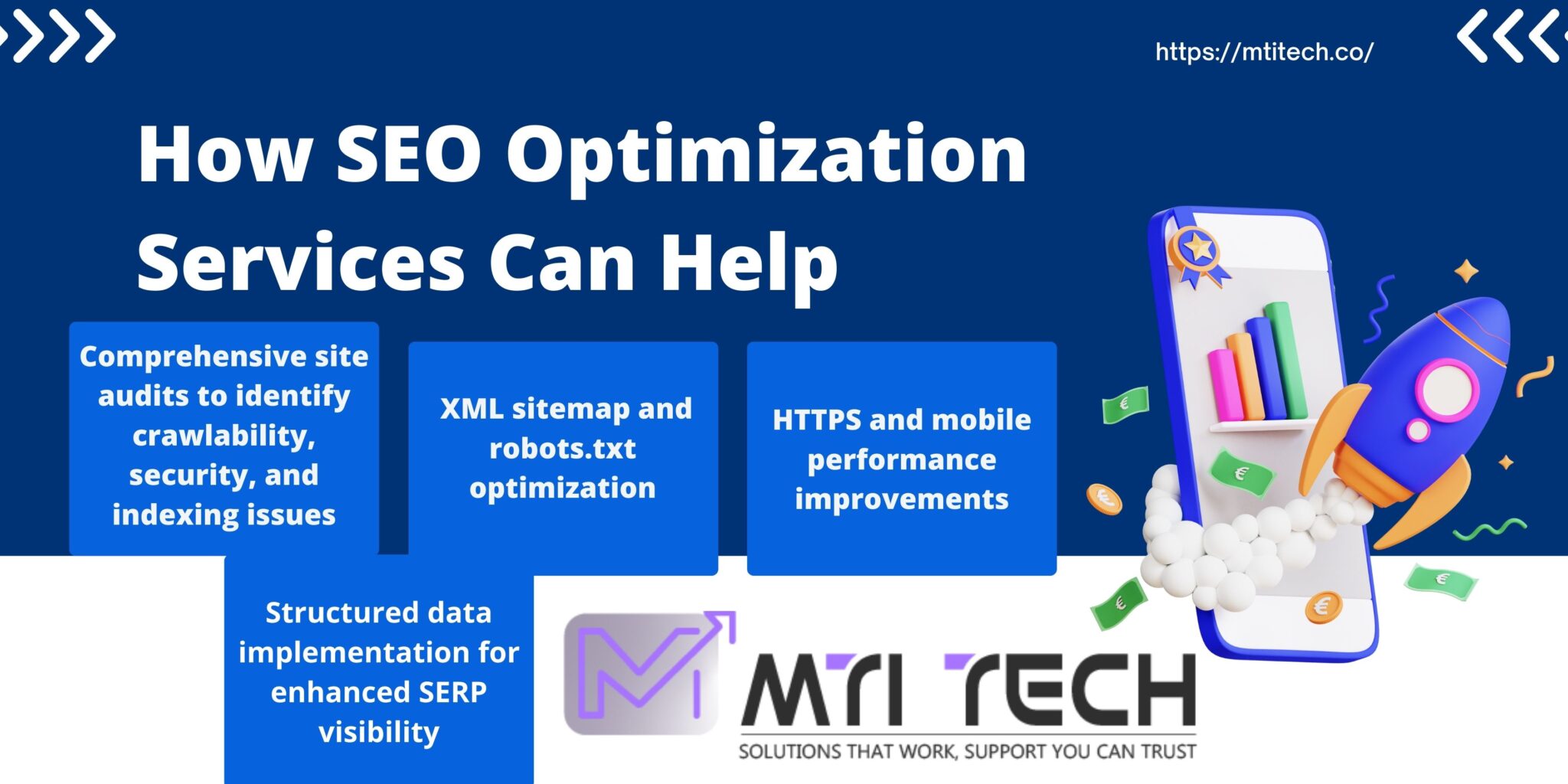
XML sitemap and robots.txt optimization
XML Sitemap: A roadmap for search engines to find your important pages.
Robots.txt: A file that tells search engines which pages to crawl and which to ignore.
An optimized sitemap ensures search engines index all your valuable content.
Properly configured robots.txt prevents accidental blocking of important pages.HTTPS and mobile performance improvements
HTTPS: Ensures your website connection is secure, protecting users’ data.
Mobile Performance: Focuses on page speed and responsive design for smartphones and tablets.
Google considers HTTPS a ranking factor.
Slow or non-responsive mobile pages lead to poor user experience and lower rankings.
- Structured data implementation for enhanced SERP visibility
Structured data (schema markup) is code added to your website that helps search engines understand your content. It can display your pages as rich results in search results, showing stars, prices, event dates, and more.
Rich snippets improve click-through rates (CTR) by making your listings more attractive. Helps Google understand the type of content you offer, improving indexing accuracy.
By relying on experts, businesses can ensure that their website is fully optimized, allowing great content to perform its best and rank effectively.
Conclusion
Even the most outstanding content can fail to rank if your website has hidden technical SEO issues. From crawlability problems to HTTPS misconfigurations, XML sitemap errors, slow mobile pages, and missing structured data each issue can silently hurt your rankings.
Investing in professional SEO Optimization Services ensures that these hidden errors are discovered and resolved, giving your content the foundation it needs to rank and attract organic traffic.
Remember, content alone is not enough. A technically healthy website is the backbone of SEO success. Take action today and audit your website to uncover any hidden errors before they hold back your rankings.