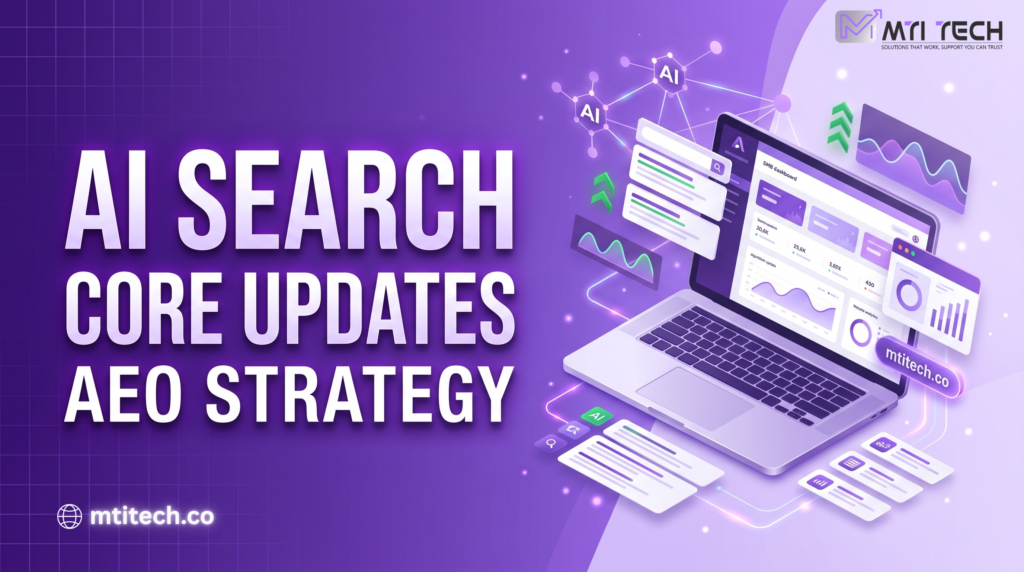
The Death of the Keyword: Why AEO is Your Business Survival Guide in the AI Era
Introduction: The Silent Shift in How We Search
Imagine this scenario: It is 2026. A potential customer picks up their phone. They don’t open a browser. They don’t type “best digital marketing agency Lahore” into a search bar. They don’t scroll past ads, and they certainly don’t click on three different websites to compare services.
Instead, they simply speak to their AI assistant:
“Hey, find me a reliable digital agency that specializes in high-end UX design and has good reviews for medical tech.”
The AI pauses for a millisecond, processes the request, and responds with a single, definitive answer:
“I recommend MtiTech. They have a strong track record in UX design for the healthcare sector and consistently positive client feedback regarding their strategic approach.”
End of search. The customer is sold.
If your business was optimized for Google “keywords” but not for that AI’s “understanding,” you were never even in the running. You didn’t just lose the click; you lost the existence game.
This is the new reality of the internet. For the last twenty years, we have been obsessed with Search Engine Optimization (SEO)—the art of ranking on a list of blue links. But the era of the “search list” is ending. We are entering the era of the Answer Engine.
Users are no longer looking for a list of options to sift through; they are looking for Serenity. They want the answer, immediately, without the friction of browsing.
In this guide, we are going to explore Answer Engine Optimization (AEO). We will break down why the “keyword” is dying, how AI models like ChatGPT, Gemini, and Perplexity “read” your business, and the exact steps you need to take to ensure that when the AI speaks, it speaks your name.
What is AEO and How Does it Differ from SEO?
To survive this shift, we first have to unlearn some of the habits we’ve built over the last decade. Many business owners assume that if they rank #1 on Google, they will automatically be the top recommendation by an AI. This is a dangerous misconception.
While SEO and AEO are cousins, they play by entirely different rules.
1. SEO: The Game of “Blue Links”
Traditional Search Engine Optimization (SEO) is designed for a retrieval system. When you type a query into Google, the algorithm acts like a librarian. It runs to the back of the room, grabs every book (website) that mentions your keywords, and stacks them in a pile (the search results page) for you to sort through.
- The Goal: To get your “book” to the top of the stack.
- The Method: Keywords, backlinks, meta tags, and URL structure.
- The User Experience: The user has to do the work of clicking, reading, and deciding.
2. AEO: The Game of “Synthesized Answers”
Answer Engine Optimization (AEO) is designed for a synthesis system. AI models (LLMs) do not just retrieve links; they read, understand, and summarize information. When a user asks a question, the AI acts like a consultant. It reads the books for you, synthesizes the information, and gives you a direct recommendation.
- The Goal: To be the primary source cited in the AI’s direct answer.
- The Method: Entities, context, structured data, and authority.
- The User Experience: The user gets the answer instantly. Zero clicks required.
3. The “Zero-Click” World
The biggest threat—and opportunity—of AEO is the concept of the “Zero-Click Search.”
In traditional SEO, success was measured by traffic: how many people clicked your link. In an AEO world, traffic volume might actually decrease, but the quality of that traffic will skyrocket.
If a user asks ChatGPT for a recommendation and it suggests your brand, that user arrives at your site already convinced. They aren’t “shopping around”; they are validating a recommendation from a trusted source.
Therefore, AEO isn’t about getting found; it’s about being understood. It is about ensuring that when an AI crawls your digital footprint, it clearly understands:
- Who you are (Identity).
- What you do (Services).
- Why you can be trusted (Authority).
If your website is a mess of keywords without clear context, the AI will hallucinate, or worse, ignore you entirely.
How AI Models “Read” Your Business: It’s Not About Words, It’s About Meaning
To master AEO, you must understand how Artificial Intelligence “reads.”
In the old days of Google, search engines were essentially sophisticated matching games. If you wanted to rank for “Best Pizza,” you wrote the words “Best Pizza” ten times on your homepage. It was a game of Strings (text characters).
AI models, however, play a game of Things (concepts and entities).
1. Semantic Search: Reading Between the Lines
AI uses “Semantic Search,” which means it tries to understand the intent and context behind a query, not just the literal words.
For example, if a user searches for “Apple,” a traditional keyword engine might struggle to know if they mean the fruit or the iPhone. An AI looks at the context. If the user previously asked about “vitamins,” the AI knows “Apple” means fruit. If they asked about “iOS updates,” it means the tech giant.
For your business, this means you can no longer trick the system with keyword stuffing. You must provide deep, context-rich content that clearly defines your industry, your location, and your specific expertise.
2. The Power of “Entities”
This is the most critical concept in AEO. AI organizes information into Entities.
- An Entity is a distinct thing—a person, a place, a business, or a concept.
- Attributes are the facts connected to that entity.
For an AI to recommend MtiTech, it must first recognize “MtiTech” as a distinct Entity in its Knowledge Graph. It needs to connect the dots:
- Entity: MtiTech
- Attribute: Is a Digital Agency
- Attribute: Is located in Lahore
- Attribute: Specializes in UX Design
- Relationship: Has positive reviews on Clutch/Google
If your digital footprint is fragmented—for example, if your Facebook says you are a “Graphic Design Firm” but your website says “Software House”—the AI gets confused. When an AI is confused, it stays silent. Consistency is the key to becoming a trusted Entity.
The Three Pillars of AEO Strategy
So, how do we teach the AI to trust us? We focus on three strategic pillars that serve as the foundation of Answer Engine Optimization.
Pillar 1: Authority & Credibility (E-E-A-T)
Google and AI models prioritize content that demonstrates E-E-A-T:
- Experience
- Expertise
- Authoritativeness
- Trustworthiness
AI algorithms are trained to avoid giving “wrong” advice, especially in business or health matters. They prefer to cite sources that have proven authority.
How to build it:
- Author Bios: Never publish blog posts by “Admin.” Always attribute them to a real expert at your company (e.g., “Written by [Name], Senior UX Strategist”).
- Backlinks from Reputable Sites: If a major tech news site mentions your agency, the AI sees that as a “vote of confidence.”
- Citations: Ensure your business name, address, and phone number (NAP) are listed identically across valid directories.
Pillar 2: Structured Data (Schema Markup)
This is the technical backbone of AEO. “Schema Markup” is a specific code you put on your website that translates your content into a language robots can understand natively.
Think of your website as a foreign film. Schema is the subtitles.
- Without Schema: The AI guesses that “4.5” on your page might be a rating.
- With Schema: You explicitly tell the AI, <rating>4.5</rating>.
Why it matters:
When you use Schema to tag your FAQs, Services, and Reviews, you make it incredibly easy for an AI to scrape that specific data and present it as a direct answer. If you make the AI’s job easy, it rewards you with visibility.
Pillar 3: The Q&A Format (Writing for NLP)
Natural Language Processing (NLP) is how computers understand human speech. To rank in AEO, you need to write the way people speak.
Most users ask AI questions: “How much does a custom website cost?”
Your content should mirror this structure directly.
The Strategy:
Don’t bury the lead. If you are writing a section about cost, do not write three paragraphs of fluff before giving the number.
- Question (Header): How much does a custom website cost?
- Answer (First Sentence): A custom website typically costs between $X and $Y depending on complexity…
This “Inverted Pyramid” style allows the AI to grab that specific snippet and serve it as the answer.
Why Voice Search is the “Silent Partner” of AEO
You cannot talk about Answer Engines without talking about Voice Search. With the rise of Siri, Alexa, and Google Assistant, the way people interact with the web has fundamentally changed.
When we type, we use “Computer Language.” We type: “Weather New York.”
When we speak, we use “Human Language.” We ask: “Hey Google, do I need an umbrella today in New York?”
This shift is critical for AEO because voice assistants read out one answer. There is no “Page 2” on Alexa. There is only the best answer, or silence.
The Local Connection
Voice search is overwhelmingly local. People drive and ask, “Where is the best coffee shop near me?” or “Find a marketing agency open right now.”
For businesses, this means your Local SEO must be flawless. If your Google Business Profile is outdated, or your operating hours are missing, the voice assistant will skip you. In the world of AEO, accuracy is the currency you pay to be seen (or heard).
How to Optimize Your Brand for AEO Today
The shift to AEO might sound intimidating, but it is actually an opportunity to clean up your digital house. Here is your roadmap to becoming an entity that AI loves to recommend.
1. Audit Your Digital Identity (The “Consistency” Check)
AI models get confused by conflicting data.
- Action: Google your own business name. Check your website, LinkedIn, Facebook, Clutch, and Google Business Profile.
- The Fix: Ensure your Name, Address, Phone Number (NAP), and “About Us” descriptions are identical across all platforms. You are solidifying your “Entity.”
2. Create “Hub” Content (Topic Clusters)
Stop writing random blog posts. Start building “Knowledge Hubs.”
- Action: Choose a core topic you want to own (e.g., “UX Design”). Write one massive “Pillar Page” (like this guide) that covers everything.
- The Fix: Link this pillar page to smaller, specific articles (e.g., “UX for Mobile,” “UX for E-commerce”). This tells the AI: “We are the authority on this entire topic.”
3. Implement Speakable Schema
- Action: Ask your developer to add Speakable schema markup to your key content.
- The Fix: This specific code tells voice assistants, “If someone asks about this topic, read this specific section aloud.” It is a direct ticket to being the voice of Siri.
4. The FAQ Attack
- Action: Gather the top 10 questions your sales team gets asked on the phone.
- The Fix: Create a dedicated FAQ page. Write the question exactly as a customer asks it, and write the answer concisely (under 40 words if possible) before expanding. This targets the “Featured Snippet” and AI summaries directly.
Conclusion: The Future belongs to the “Understood”
The internet is becoming less of a library and more of a conversation.
For the last two decades, businesses have fought to be found. In the next decade, the winners will be the businesses that are understood.
The transition from Search Engine Optimization (SEO) to Answer Engine Optimization (AEO) isn’t just a technical update; it’s a fundamental shift in how we present value to the world. It requires us to move away from tricks and keywords, and toward authority, clarity, and genuine helpfulness.
At MtiTech, we aren’t just watching this shift happen; we are building the infrastructure for it. We help brands structure their data, refine their identity, and create the kind of high-value content that AI models trust—and customers love.
Is your business ready for the AI era?
Don’t let your brand become invisible in the age of answers. Contact MtiTech today, and let’s audit your digital footprint to ensure that when the future asks a question, your business is the answer.