The Science of Landing Pages: 5 Psychological Triggers That Double Conversions
In the world of Digital Marketing Services, traffic is no longer the biggest problem, conversion is. Brands spend thousands on ads, SEO, and social media only to funnel users onto landing pages that quietly fail. No errors. No crashes. Just… silence.
The truth is uncomfortable but clear:
Most landing pages don’t fail because of bad design. They fail because they ignore human psychology.
Landing pages are not digital brochures. They are controlled psychological environments. Every color, headline, button, image, and sentence either reduces friction, or creates it.
This article takes a scientific, CRO-driven approach to landing page optimization. Instead of generic “best practices,” we’ll explore five proven psychological triggers rooted in behavioral science, neuroscience, and real user behavior patterns, triggers that top Digital Marketing Services use to consistently double (and sometimes triple) conversions.
Why Psychology Is the Hidden Engine Behind High-Converting Landing Pages
Before we dive into the triggers, it’s important to reframe how we think about landing pages.
A landing page has one job:
Move a distracted human brain toward a single action.
But humans don’t behave logically online. They behave:
- Emotionally
- Predictably
- Lazily
- Under cognitive load
Modern CRO (Conversion Rate Optimization) is less about creativity and more about understanding:
- How people read screens
- How they process risk
- How they respond to authority
- How they avoid pain
That’s why elite Digital Marketing Services rely heavily on behavioral psychology, not opinions.
Trigger #1: Visual Hierarchy & the F-Pattern Reading Behavior
People don’t read landing pages, they scan them.
Eye-tracking studies from Nielsen Norman Group consistently show that users scan web pages in an F-shaped pattern:
- A horizontal scan at the top
- A second shorter horizontal scan
- A vertical scan down the left side
If your landing page doesn’t align with this natural behavior, users won’t see your most important message, even if it’s brilliant.
How the F-Pattern Impacts Conversions
High-performing Digital Marketing Services design landing pages where:
- The main value proposition sits at the top-left
- Supporting proof follows directly beneath
- CTAs appear where the eye naturally pauses
When key information is placed outside the F-pattern, users experience cognitive friction, and friction kills conversions.
Virality is overrated, unpredictable, and rarely profitable.
Brands don’t fail on social media because they didn’t go viral. They fail because they built their strategy on hope instead of systems. In contrast, businesses that quietly post consistently, engage daily, and support community are the ones generating sustainable revenue.
This article takes a contrarian stance, debunking the myth of virality and explaining why consistency, repetition, and community engagement are the real engines behind successful Digital Marketing Services.
The Viral Myth: Why Everyone Is Chasing the Wrong Goal
Virality feels powerful because it’s visible. Numbers spike. Notifications explode. Dopamine hits.
But visibility is not the same as value.
Let’s break down why viral content is a poor foundation for long-term growth.
1. Virality Is Random, Not Strategic
You can increase your odds, but you can’t engineer virality with certainty. Algorithms reward behavior, timing, audience mood, trends, and sometimes pure luck.
That means:
- A great post may flop
- A mediocre post may explode
- Success can’t be reliably repeated
No serious business would build revenue on something this unstable, yet many social media strategies do exactly that.
2. Viral Audiences Are Often the Wrong Audiences
A viral reel reaches everyone, not your people.
You might attract:
- Users outside your target market
- People interested in entertainment, not solutions
- Viewers who never intended to buy
High views with low relevance lead to inflated metrics and empty pipelines. For companies offering professional Digital Marketing Services, relevance matters more than reach.
3. Virality Rarely Converts to Revenue
Ask this simple question:
Did this viral post generate qualified leads, sales, or long-term customers?
Most of the time, the answer is no.
Virality creates attention spikes, not trust. And trust, not views, is what converts.
The Quiet Power of Consistency (That No One Brags About)
Consistency is boring. There’s no screenshot-worthy spike. No overnight miracle.
But consistency compounds.
What Consistency Actually Means
Consistency isn’t posting every day just to stay visible. It means:
Showing up on a predictable schedule
Repeating your core message in different formats
Educating before selling
Staying relevant in your audience’s feed
Over time, your brand becomes familiar, and familiarity builds trust. But more importantly, consistency reduces decision fatigue for your audience. When people know what kind of value to expect from your content, they don’t have to rethink whether to engage with you. You become a dependable presence in their feed, not a random interruption.
Consistency also sharpens your brand identity. Repeating your core ideas doesn’t make your message weak, it makes it clear. The strongest brands in social media marketing are remembered not because they said everything, but because they said the right things repeatedly, with purpose and relevance.
In practical terms, consistency helps your audience move from passive consumption to active consideration. They may scroll past your first few posts. They may not engage at all initially. But with time, repetition, and value-driven content, your brand shifts from being “just another account” to a familiar expert they subconsciously trust, long before they ever click, comment, or convert.
Trust Is the Real Conversion Trigger
People don’t buy from brands they just discovered. They buy from brands they recognize.
Consistency creates:
- Brand recall
- Authority
- Perceived reliability
In social media marketing, trust is built slowly but lost instantly. Consistency protects it by reducing uncertainty in the buyer’s mind.
When people repeatedly see your brand show up with useful, relevant content, their perception shifts, even if they never interact. You move from being an unknown option to a familiar presence. And familiarity lowers resistance. It makes clicking, messaging, or booking a call feel safer.
Trust also acts as a filter during the decision-making process. When prospects compare multiple brands offering similar services, they instinctively lean toward the one they recognize most. Not necessarily the cheapest. Not necessarily the loudest. The one that has been consistently present, educating and showing credibility over time.
This is why consistency is not just a content habit, it’s a conversion strategy. It shortens sales cycles, improves lead quality, and increases the likelihood that when your audience is finally ready to buy, your brand is the one they choose.
Actionable Optimization Tips
- Place your headline where the eye lands first
- Keep subheadings scannable, not poetic
- Use bullet points aligned to the left
- Avoid center-heavy text blocks early on
A scientifically structured page doesn’t look fancy, it looks effortless to understand.
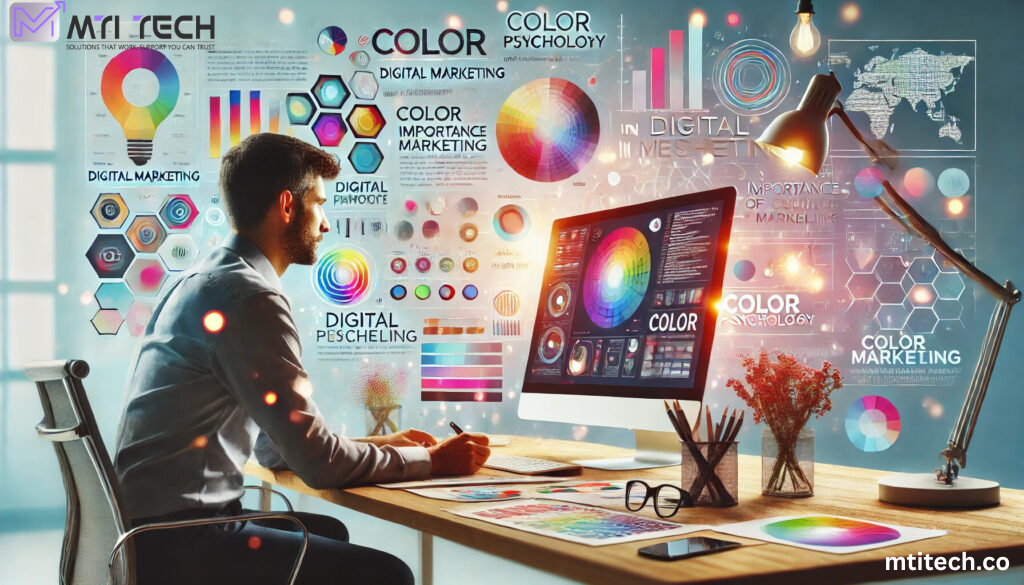
Trigger #2: Color Psychology & Cognitive Fluency
Color doesn’t persuade, clarity does.
One of the most persistent myths in Digital Marketing Services is the idea that certain colors magically convert better than others. Red buttons are supposed to create urgency. Green buttons signal safety. Orange buttons “stand out more.”
The truth is far more nuanced, and far more scientific.
Color on its own doesn’t persuade anyone to act. Clarity does.
Color only becomes powerful when it helps the brain understand faster and decide with less effort.
That’s where cognitive fluency comes in.
Cognitive fluency refers to the brain’s natural preference for information that is easy to process. When something feels familiar, clear, and visually organized, the brain interprets it as safer and more trustworthy, often without conscious awareness.
Why Cognitive Fluency Drives Conversions
When a user lands on a page, their brain immediately switches into evaluation mode. Within milliseconds, it asks three silent questions:
- What is this?
- Is this safe and credible?
- What do you want me to do next?
Color plays a crucial role in answering these questions quickly.
If the visual environment is clean and predictable, the brain relaxes. If colors clash, compete, or send mixed signals, the brain hesitates. And hesitation is dangerous in conversion-focused environments, because hesitation gives users time to leave.
This is why high-performing Digital Marketing Services don’t chase trendy color palettes. They design for mental ease.
Color as a Directional Tool, Not Decoration
On high-converting landing pages, color functions like a silent guide. It subtly tells users where to look, what matters, and what action to take.
Strategic color use:
- Directs attention toward primary actions
- Separates information into digestible sections
- Creates a sense of structure and order
- Reinforces trust and professionalism
Random or decorative color use does the opposite. It forces users to think, re-evaluate, and second-guess.
In CRO terms, every unnecessary decision increases cognitive load, and increased cognitive load reduces conversion probability.
High-Converting Color Principles Used by Digital Marketing Services
- Contrast Over Brightness
High contrast matters more than vibrant color. A CTA should stand out clearly against its background, not because it’s loud, but because it’s distinct. Subtle contrast often outperforms aggressive brightness because it feels intentional rather than desperate. - One Primary Action, One Dominant Color
Your main CTA should own a single, consistent color across the page. When multiple elements share the same color, users lose their visual anchor. Elite Digital Marketing Services ensure that the CTA color means action, and nothing else. - Limited Palette = Faster Decisions
A restrained color palette reduces mental effort. When users don’t have to visually sort competing colors, they focus on the message instead of the design. Fewer colors create faster comprehension and smoother user flow. - Consistent Color Meaning
Colors should never change roles. If one color represents action, it should never be used for decoration. If another color represents information or reassurance, it should remain consistent throughout the page. Consistency builds trust, even when users don’t consciously notice it.
Trust, Safety, and Color Perception
Color also impacts how safe a page feels. Muted, balanced tones often communicate stability and professionalism, while chaotic or overly aggressive colors can subconsciously signal risk.
This is especially critical for pages offering Digital Marketing Services, where users are evaluating expertise, credibility, and long-term value. A visually calm page suggests competence. A visually noisy page suggests uncertainty.
When users feel safe, they move forward. When they feel overwhelmed, they leave.
The CRO Takeaway
Color doesn’t convince users to convert.
It removes the mental obstacles that stop them from converting.
When color reduces confusion, decision fatigue, and uncertainty, conversions increase naturally.
That’s why the most successful Digital Marketing Services don’t ask, “Which color converts best?”
They ask, “Which color makes the decision easiest?”
And in conversion optimization, easy always wins.
Trigger #3: Social Proof & the Bandwagon Effect
Humans trust other humans more than brands.
No matter how strong your copy is, users still ask:
“Has this worked for someone like me?”
This is the Bandwagon Effect, our instinct to follow decisions already validated by others.
Why Social Proof Multiplies Conversions
Psychologically, social proof reduces:
- Perceived risk
- Fear of regret
- Decision fatigue
Landing pages without proof forces users to take all the risk themselves.
Types of Social Proof That Actually Convert
Not all testimonials are equal. High-impact Digital Marketing Services use:
- Specific results (“Increased conversions by 42% in 30 days”)
- Logos of recognizable clients
- Short video testimonials
- Real photos with names and roles
Generic praise like “Great service!” does nothing for the brain.
Placement Matters More Than Quantity
- Place proof near CTAs
- Use it right after major claims
- Reinforce trust at decision points
Social proof doesn’t decorate your page, it removes fear.
Trigger #4: Loss Aversion & Urgency (Without Manipulation)
People hate losing more than they love winning.
This principle, known as loss aversion, explains why urgency works, when done ethically.
The human brain assigns more emotional weight to potential loss than potential gain. Smart Digital Marketing Services leverage this by highlighting:
- What users miss if they don’t act
- What stays broken if they delay
Ethical Urgency vs. Fake Scarcity
Fake countdown timers and false scarcity damage trust. Instead, use contextual urgency:
- Limited onboarding slots
- Expiring bonuses
- Time-based results (“Every day you wait costs traffic”)
Conversion-Focused Techniques
- Frame offers around avoiding loss, not chasing gain
- Use micro-urgency near CTAs
- Reinforce timing naturally within copy
Urgency should feel helpful, not aggressive.
Trigger #5: Choice Reduction & the Paradox of Simplicity
More options don’t increase conversions, they reduce them.
According to Hick’s Law, the more choices a person has, the longer they take to decide, or they don’t decide at all.
Many landing pages fail because they try to:
- Explain everything
- Offer too many actions
- Satisfy every audience
Elite Digital Marketing Services understand one truth:
Every landing page should have one dominant action.
How Choice Overload Kills Performance
- Multiple CTAs split attention
- Long forms increase abandonment
- Excessive features overwhelm users
How to Simplify for Higher Conversions
- One primary CTA
- One clear value proposition
- Minimal form fields
- Remove navigation where possible
Clarity converts. Complexity repels.
How Digital Marketing Services Use These Triggers Together
The real power isn’t in individual tactics, it’s in integration.
High-performing landing pages:
- Guide the eye (visual hierarchy)
- Reduce thinking (color & layout)
- Build trust (social proof)
- Create motivation (loss aversion)
- Remove friction (simplicity)
This is why professional Digital Marketing Services outperform DIY pages, not because of tools, but because of behavioral understanding.
Measuring the Psychological Impact: CRO Is a Science
You don’t guess whether psychology works, you test it.
Professional Digital Marketing Services rely on behavioral data to understand how users think, hesitate, and decide. Metrics like:
- Scroll depth (where attention drops)
- Heatmaps (what attracts or ignores attention)
- Click patterns (clarity vs. confusion)
- Form abandonment (friction or fear points)
- Conversion paths (decision flow)
These insights reveal not just what users do, but why they do it.
Effective CRO isn’t about redesigning entire pages. It’s about making small, evidence-based refinements, adjusting layout, copy, or placement, to reduce cognitive load and increase confidence.
That’s why conversion optimization works best when treated as a science, not a guessing game.
Final Thoughts: Why Conversion Psychology Is the Future of Digital Marketing Services
Traffic will only get more expensive. Attention spans will only get shorter. In this environment, conversion optimization is no longer optional.
The brands that win won’t be louder, they’ll be smarter.
By applying these five psychological triggers, your landing pages stop being static assets and start becoming conversion systems, systems built on how humans actually think.
That’s the difference between a landing page that looks good…
and one that quietly doubles revenue.