How Optimizing PO Processing Drives Logistics Success
Imagine this scenario: A 40-foot container arrives at the port of Los Angeles. The vessel has docked, the crane has lifted the box, and the truck driver is waiting at the gate. Everything physically required to move these goods is in place.
Yet, the truck engine remains off. The container sits in the yard, accruing thousands of dollars in demurrage fees every day. The production line in Ohio that needs these parts is forced to shut down.
Why? Not because of a broken engine or a strike, but because of a PDF.
Perhaps the Commercial Invoice didn’t match the Purchase Order (PO). Maybe the Incoterm was recorded incorrectly, shifting the customs responsibility to the wrong party. Or perhaps the vendor simply never confirmed the “Ready Date,” and the goods arrived two weeks earlier than the warehouse was prepared to receive them.
In the world of modern logistics, we often focus on the physical infrastructure—ships, trucks, and warehouses. But the true driver of supply chain efficiency is information.
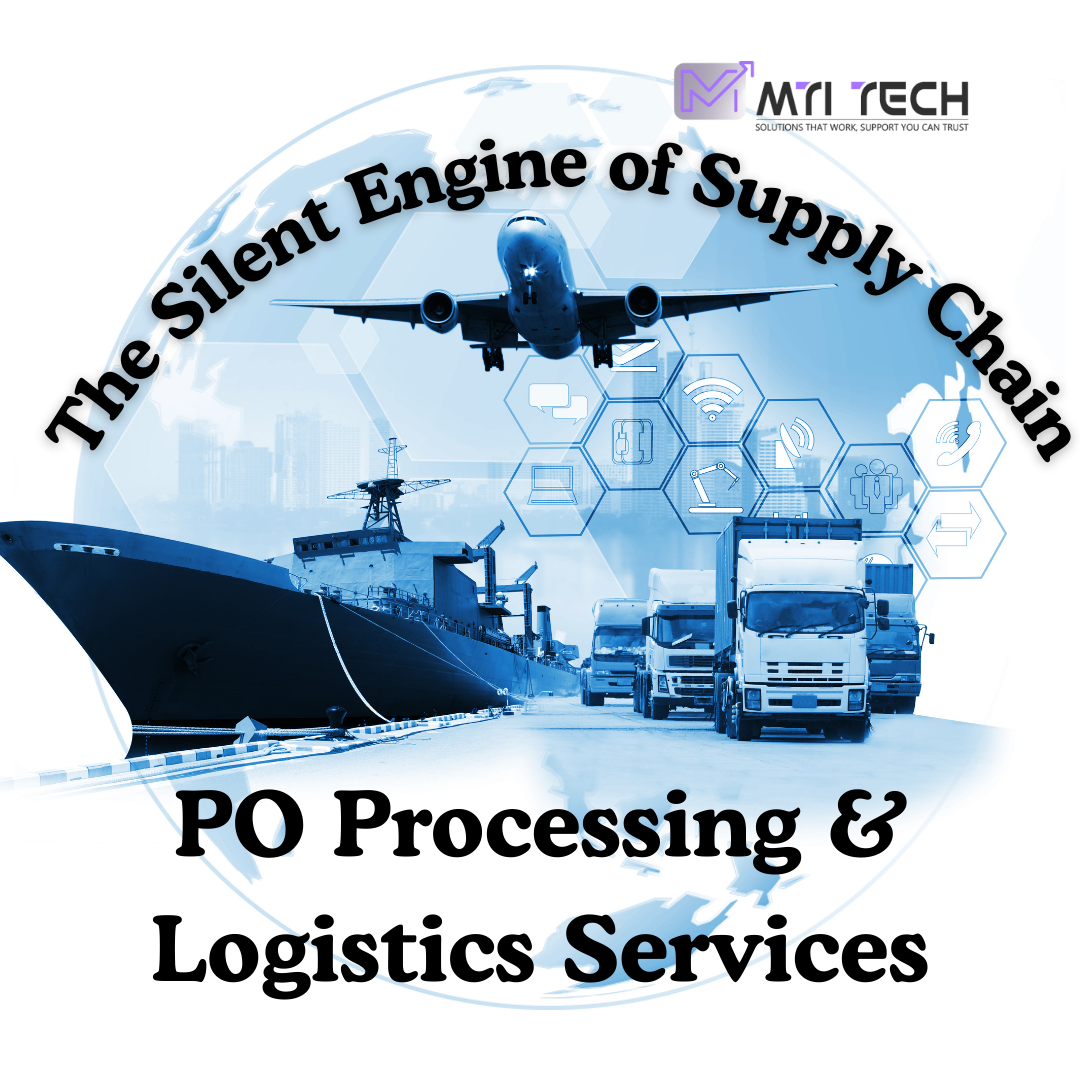
At MTI Tech, we view Purchase Order (PO) Processing not as a boring administrative task, but as the “Silent Engine” of logistics. If the data is clean at the start, the shipment moves fast. If the data is dirty, the shipment stops.
This article explores the critical, often overlooked link between PO Processing and Logistics, and how outsourcing these functions to a specialized partner can transform your supply chain from a cost center into a competitive advantage.
Why PO Processing is Logistics
There is a misconception in many organizations that Procurement and Logistics are two separate islands.
- Procurement’s Job: Negotiate the price, raise the PO, and “buy” the goods.
- Logistics’ Job: Pick up the goods and move them from Point A to Point B.
In reality, these two functions are inextricably linked. The Purchase Order is the “Source of Truth” for the entire logistics lifecycle. It dictates what is moving, when it must arrive, how it should be packed, and who pays for the freight.
The “Garbage In, Garbage Out” Problem
If the source of truth is flawed, the entire downstream process is poisoned. This is the classic “Garbage In, Garbage Out” principle applied to supply chain management.
Consider a simple data entry error:
- The Error: A junior buyer enters the wrong HS Code (Harmonized System) on a PO for a batch of steel components.
- The Ripple Effect: The vendor uses this wrong code on their export documents. The freight forwarder files the ISF (Importer Security Filing) using the wrong code.
- The Consequence: Customs Border Protection (CBP) flags the shipment for an intensive exam. The container is held for 10 days. The cost of the exam + storage fees + missed production capability = $15,000 loss.
All because of a typo on a document created six weeks earlier.
This demonstrates that PO Processing is not just data entry; it is the first step of logistics execution.
Where the Supply Chain Breaks Down
Through our work at MTI Tech, we have identified five common bottlenecks where the disconnect between PO Processing and Logistics causes the most pain.
1. Manual Vendor Acknowledgment (The “Black Hole”)
You send a PO via email. Then… silence. You assume the vendor has accepted the price and the delivery date. Three weeks later, your logistics coordinator calls to book the shipment, only to hear: “Oh, didn’t you get our email? We can’t ship until next month.”
This lack of confirmed data leaves logistics teams scrambling to find expensive expedited freight solutions.
2. Document Mismatches
The Packing List says 500 cartons. The Bill of Lading says 505 cartons. The PO says 450 cartons.
When these three documents don’t align perfectly, the shipment is effectively paralyzed. Customs brokers cannot clear it, and warehouses cannot receive it.
3. Visibility Blind Spots
“Where is my stuff?” is the most common question in logistics. But the answer is often useless if it’s not tied to the PO. Knowing that “Container XYZ is in Rotterdam” doesn’t help the Sales Manager who needs to know “Where is the order for the new Fall Collection?”
Without linking PO line items to tracking numbers, business intelligence is lost.
4. Invoice Discrepancies
The goods arrive, but the fight is just beginning. The vendor invoice doesn’t match the PO price. The logistics invoice has “Waiting Time” charges that weren’t approved. The Accounts Payable (AP) team freezes payment, damaging vendor relationships and credit terms.
5. High Operational Costs
Perhaps the most tragic waste is human potential. Highly skilled Logistics Managers, earning six-figure salaries to strategize supply routes, often spend 40% of their day doing low-value data entry—manually keying in commercial invoices or chasing vendors for PDF confirmations.
MTI Tech’s “Tech-Enabled” BPO Approach
So, how do we fix this? The answer lies in Specialized Business Process Outsourcing (BPO).
However, not all BPO is created equal. A standard call center can answer phones, but they cannot manage a supply chain.
MTI Tech offers a different model. As a Software House & BPO Provider, we combine human expertise with custom technological integration. We act as the bridge that connects your ERP, your vendors, and your freight forwarders.
Software + Strategy
We don’t just throw bodies at the problem; we throw code at it.
- Automated Extraction: We use OCR (Optical Character Recognition) and AI to “read” PDF Purchase Orders and Vendor Confirmations, extracting data with 99.9% accuracy in seconds.
- API Integrations: We build custom connections between your system and carrier portals (Maersk, FedEx, DHL), allowing data to flow without manual re-keying.
The Human-in-the-Loop
Technology handles the data, but humans handle the relationships. Our specialized logistics agents step in to manage the complexity that software can’t:
- Negotiating with a vendor who wants to split a shipment.
- Deciding whether to authorize an air freight upgrade to meet a deadline.
- Resolving a dispute over damaged packaging.
The Integrated Workflow (Step-by-Step)
What does an optimized “Silent Engine” look like in practice? Here is the workflow MTI Tech implements for our logistics clients.
Step 1: Precision PO Entry & Validation
Before a PO is ever sent to a vendor, MTI Tech agents validate it. We check against the contract database: Is the pricing correct? Is the Incoterm valid for this lane? Is the lead time realistic? This proactive scrub prevents errors before they leave the building.
Step 2: Proactive Vendor Coordination
We don’t rely on “passive email.” Our team actively chases the Vendor Acknowledgment. We ensure the vendor commits to a specific “Cargo Ready Date.” If they don’t reply within 24 hours, our system triggers an escalation protocol. We turn the “Black Hole” into a transparent window.
Step 3: Pre-Shipment Document Scrub
This is the most valuable step in the process. Before the goods leave the factory floor, our team reviews the draft shipping documents (Commercial Invoice, Packing List, Certificate of Origin). We ensure they match the PO exactly. If there is a mismatch, we force the vendor to correct it before the ship sails. This eliminates 90% of customs holds at the destination.
Step 4: Logistics Coordination
Armed with verified data, our team coordinates with freight forwarders. We book the vessel or truck based on the confirmed ready date, not the estimated one. We provide the forwarder with clean, digital data, ensuring the Bill of Lading is issued correctly the first time.
Step 5: The 3-Way Match & Payment
Once delivery occurs, we close the loop. Our system performs an instant 3-Way Match:
- The PO (What we ordered)
- The GRN (What the warehouse counted)
- The Invoice (What the vendor billed)
If they match, the payment is scheduled. If not, an MTI Tech agent investigates and resolves the discrepancy immediately.
A Tale of Two Companies
To illustrate the financial impact of this approach, let’s look at two hypothetical manufacturing firms.
Company A (The Manual Approach)
Company A sends POs via email. Their vendor in Vietnam falls behind schedule but forgets to notify them. Company A books a container for a Monday, but the goods aren’t ready. The truck dry runs (cost: $500).
When the goods finally ship, they miss the ocean vessel deadline. To keep the factory running, Company A has to fly the pallets (cost: $12,000).
When the goods arrive, the invoice has a discrepancy. The vendor is not paid for 60 days, straining the relationship.
Company B (The MTI Tech Partner)
Company B uses MTI Tech. Our system flags that the vendor hasn’t acknowledged the ready date. An agent calls the vendor, identifies the delay early, and adjusts the booking. No dry run fee.
Because the delay was caught early, Company B adjusts their production schedule slightly, allowing them to still ship via Ocean Freight (cost: $1,200).
MTI Tech scrubs the documents pre-shipment. The goods clear customs in 24 hours. The 3-way match is automatic, and the vendor is paid on time.
The Result: Company B saved $11,300 on a single shipment, simply by managing the information better.
AI & Predictive Logistics
The future of logistics is not just about reacting to orders; it’s about predicting them. As a software-forward company, MTI Tech is already helping clients transition to Predictive Logistics.
By analyzing historical PO data, we can start to predict lead time variances. If Vendor X is late 20% of the time in November, our AI can suggest placing the PO two weeks earlier this year. We are building “Control Tower” dashboards that blend financial data (PO value) with physical data (GPS location), giving CFOs and COOs a single view of their supply chain risk.
Conclusion
Logistics is a physical business, but it runs on a digital fuel called data. You cannot have a fast, efficient supply chain if your back-office engine is clogged with paper, errors, and delays.
By outsourcing your PO Processing and Logistics Support to MTI Tech, you are doing more than just saving on labor costs. You are cleaning the fuel that powers your business. You are ensuring that every truck, ship, and plane is moving based on accurate, verified, and timely information.
Stop letting paperwork slow down your shipments. Let MTI Tech build the silent engine that drives your logistics success.