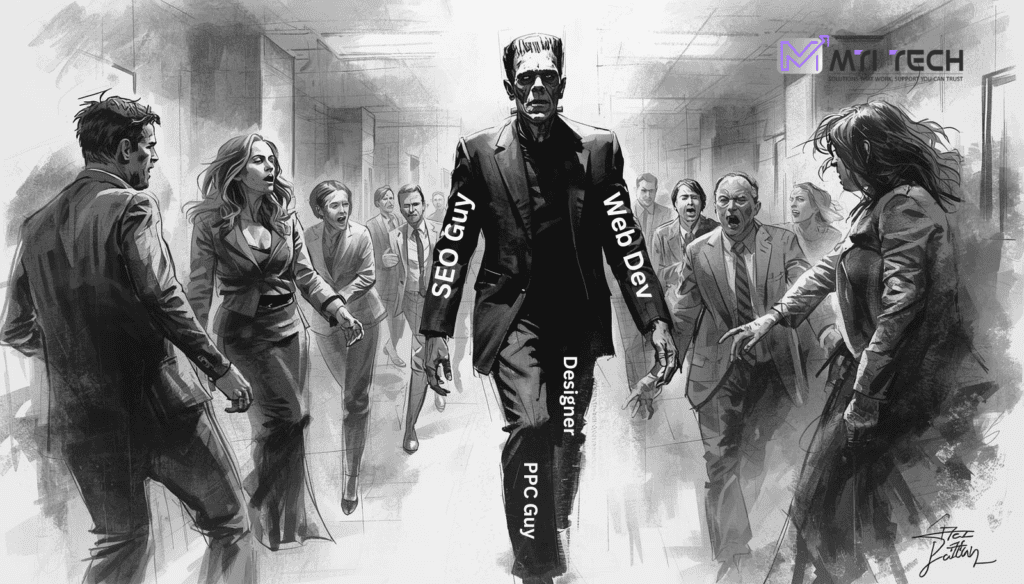
The Frankenstein Effect
We’ve all seen it happen. A business owner decides it’s time to scale. They have the budget, the ambition, and the product. So, they go out and hire the “best” talent they can find.
They hire a high-end creative agency in London to design the brand visuals.
They hire a technical freelancer for web development.
They hire a specialized SEO firm to handle the content.
And finally, they hire a PPC agency to run the ads.
On paper, this looks like a dream team. You have experts in every seat. But when launch day arrives, the business owner doesn’t get a dream result. They get Frankenstein.
Like the monster in Mary Shelley’s novel, the project is stitched together from mismatched parts. It might be “alive,” but it’s clunky, uncoordinated, and frankly, a little scary to look at.
The creative agency delivers stunning, high-resolution visuals that look incredible on a 27-inch iMac. But the developer, working in a silo, hard-codes those massive images into the site structure. The result? A website that takes 16 seconds to load.
Meanwhile, the PPC agency turns on the ads. They drive expensive, high-quality traffic to the site. But because the site is slow (thanks to the design) and the layout isn’t optimized for conversion (because the developer didn’t talk to the marketer), the users bounce immediately.
The result is a disaster loop:
- The Ad Agency blames the website speed.
- The Developer blames the heavy design assets.
- The Designer says they just followed the brand guidelines.
- And you? You are left paying four different invoices for a system that burns money instead of generating it.
This is the hidden cost of the single-focus agency model. When you buy ingredients separately, you don’t get a meal; you get a mess.
In 2026, digital dominance doesn’t come from isolated pockets of excellence. It comes from synergy. It comes from a web developer who understands SEO schema, and a digital marketer who understands User Interface (UI).
To win today, you have to stop building Frankensteins. It’s time to build a machine.
The “Vendor Gap”: Where Efficiency Goes to Die
If the “Frankenstein” effect is the visible result, the “Vendor Gap” is the hidden process that causes it.
In the traditional agency model, there is a massive, invisible wall between your service providers. The web developer builds the site, tests the code, and essentially “throws it over the wall” to the marketing team. They wash their hands of the project and move on to the next client.
This is where the trouble begins.
A week later, your marketing strategist realizes the landing page needs a specific tracking pixel to measure ad performance. Or perhaps they discover that the “Contact Us” form isn’t capturing the lead source properly.
In an integrated agency, this is a 5-minute conversation across a desk (or a Slack channel). The marketer asks, the developer tweaks, and the campaign launches.
In the siloed model, this minor change triggers a bureaucratic nightmare:
- The marketer emails you (the client) to explain the technical issue.
- You forward that email to the developer.
- The developer replies, “That wasn’t in the original scope. It will cost extra.”
- You approve the new invoice.
- Three days later, the change happens.
By the time this game of “WhatsApp” is finished, you’ve lost a week of potential sales.
We call this “Vendor Fatigue.” Instead of focusing on your business strategy, you are forced to become a General Contractor. You spend your days refereeing disputes between your SEO guy and your web guy, translating jargon back and forth, and managing mismatched timelines.
The Vendor Gap isn’t just annoying; it’s expensive. It is the dark hole where your agility, your data, and your momentum disappear.
The Synergy of “Design-Led Marketing”
So, what is the alternative to the “Frankenstein” model? It is Integration. But we don’t just mean housing a developer and a marketer in the same building. We mean a unified strategy where every line of code is written with a marketing goal in mind, and every marketing campaign is backed by technical precision.
At Mtitech, we call this Design-Led Marketing, and here is how it creates a competitive advantage that single-focus agencies can’t match:
- The “Born-Ready” Website (Dev + SEO)
In a siloed model, SEO is often applied like a coat of paint after the house is built. An SEO agency will try to “optimize” a finished site, only to realize the foundation is rotten, bloated code, poor mobile responsiveness, or messy URL structures.
When services are integrated, the website is born optimized.
Our developers understand Schema markup, Core Web Vitals, and mobile-first indexing before they write a single line of code. We don’t build a site and then try to make Google like it. We build it for Google from day one.
- Data-Driven Design (UI + CRO)
Designers love aesthetics; marketers love data. Separately, they clash. Together, they convert.
In an integrated team, the User Interface (UI) isn’t just “pretty.” It is engineered for Conversion Rate Optimization (CRO).
Because our designers have access to real-time marketing data, they don’t guess what users want. If our marketing team sees that “Book a Call” buttons perform 20% better when placed on the left side of the screen, our designers implement that immediately. The design becomes a living, breathing sales tool that evolves based on real user behavior, not just artistic preference.
- The Rapid Response Loop
The market moves fast. If a competitor launches a new offer on Tuesday, you can’t wait until Friday to update your landing page.
In an integrated agency, the feedback loop is instant. If an ad campaign isn’t converting, the marketer doesn’t just tweak the ad copy; they turn to the developer and say, “The traffic is good, but the page load speed is killing us. Let’s optimize the hero image.”
The fix happens in hours, not days. This agility is the difference between a wasted budget and a profitable quarter.
Accountability: The End of the “Blame Game”
There is an old, somewhat aggressive phrase in project management: “One throat to choke.”
It sounds harsh, but when your revenue is on the line, it is exactly what you need. It means having a single point of accountability.
In the fragmented agency model, when performance dips, the finger-pointing begins.
- Scenario: Your website leads drop by 15% in November.
- The SEO Agency says: “It’s not our fault. We sent the traffic, but the website is too slow, so people left.”
- The Web Developer says: “The website is running perfectly. The SEO agency must be targeting the wrong keywords.”
Who is right? You don’t know. And because you aren’t a technical expert, you can’t referee the argument. You are stuck in the middle, paying both of them while your sales decline.
The Integrated Advantage: Radical Ownership
When you partner with an integrated agency like Mtitech, the “Blame Game” is replaced by Unified Accountability.
Because we control both the engine (the code) and the fuel (the marketing), we have nowhere to hide and we prefer it that way. If traffic drops, we don’t look for an excuse; we look for the fix. We can instantly cross-reference our server logs with our Google Analytics to find the root cause.
- Did a server update hurt load times? We roll it back.
- Did a Google Algorithm update shift the rankings? We adjust the content.
Unified Reporting vs. The PDF Shuffle
Finally, there is the clarity of data. Instead of receiving three different PDF reports that don’t match (one from your ad guy, one from your dev, one from your social manager), you get a Single Source of Truth.
We provide a holistic view of your digital health, showing the direct line between technical performance, traffic acquisition, and bottom-line revenue. You stop managing vendors and start managing growth.
The Launch Day Scenario: A Tale of Two Strategies
Let’s leave the theory behind and look at what this synergy looks like in a high-pressure environment: Product Launch Day.
Imagine a company preparing to launch a new product. They have a tight deadline and a limited budget.
Scenario A: The Siloed Approach (The Headache)
The marketing agency creates a buzz on LinkedIn, driving thousands of users to the site. The ads are perfect. But on launch morning, the web developer (who works for a different agency) pushes the new landing page live.
- The Glitch: The “Sign Up” form has a conflict with the new CRM api.
- The Fallout: Users click “Submit,” but nothing happens. They get frustrated and leave.
- The Delay: The marketing team sees the zero-conversion rate at 10:00 AM. They email the developer. The developer is in a different time zone and doesn’t see the ticket until 4:00 PM.
- The Cost: An entire day of ad spend is wasted, and hundreds of warm leads are lost forever.
Scenario B: The Mtitech Integrated Approach (The Win)
Now, let’s look at the same launch with an integrated team.
- The Prep: Weeks before launch, our development and marketing teams meet. The marketers explain the campaign goals. The developers suggest a “Waitlist” feature to capture leads before the product is even ready.
- The Build: The developers build the landing page with the specific tracking pixels the marketers need. They test the form integration with the marketing team.
- The Pivot: Launch morning arrives. Traffic spikes. Our team watches the live analytics together. We notice users are clicking the “Learn More” button but not the “Buy Now” button.
- The Fix: The marketer says, “The pricing isn’t clear.” The developer instantly adjusts the UI to make the pricing table more prominent.
- The Result: Conversions increase by 15% within the first hour.
In Scenario B, we didn’t just fix a bug; we optimized revenue in real-time. This level of agility is impossible when your vendors are operating in silos.
Conclusion: The Future belongs to the Integrated
The digital landscape of 2026 is too complex to be managed in pieces.
Code affects content. Speed affects ranking. Design affects conversion.
These aren’t separate departments anymore; they are organs in the same body. If one fails, the whole system suffers.
For years, business owners have been told to “hire specialists.” And while expertise is crucial, expertise without communication is just noise. The “Frankenstein” model of stitching together disconnected vendors is no longer sustainable. It is too slow, too expensive, and too fragile for the modern market.
Your Choice Today
You have a choice to make for your next quarter.
You can continue to be the General Contractor of your own business, shuffling emails and WhatsApp messages between your web guy and your ad guy, paying for inefficiency, and hoping the pieces fit together.
Or, you can partner with an integrated agency that sees the whole picture.
At Mtitech, we don’t just build websites, and we don’t just run ads. We build digital ecosystems. We align your technology with your growth goals, ensuring that every dollar you spend on development amplifies your marketing, and every dollar you spend on marketing feeds back into better development.
Stop playing referee between your vendors. Start playing to win.
Ready to build a machine instead of a monster?
Contact Us today for a consultation, and let’s discuss how an integrated strategy can transform your business.
📌 Quick Summary: Key Takeaways
- The “Frankenstein” Risk: Hiring separate agencies often leads to disjointed strategies, technical conflicts, and a poor user experience.
- Speed Wins: Integrated teams communicate instantly. We fix conversion blockers in hours, not weeks.
- One Source of Truth: No more conflicting reports. You get unified accountability for both traffic and revenue.
- Born-Ready Code: We build websites with marketing and SEO baked into the foundation, not painted on afterward.