Understanding the “Attribution Nightmare” in Multi-Channel Marketing
Imagine this.
A customer discovers your brand through a Google search.
A week later, they see your Facebook ad.
Then they read one of your blogs.
Finally, an email offer pushes them to buy.
Now the big question appears on every marketer’s whiteboard:
Which channel actually got the sale?
Search? Social? Content? Email?
Welcome to what marketers call the Attribution Nightmare, one of the most misunderstood and mismanaged problems in modern Digital Marketing Services.
In a world where customers interact with brands across multiple platforms, devices, and timelines, assigning credit to a single marketing channel is no longer simple. Yet, businesses still rely on attribution to decide where to spend money, what to scale, and what to cut.
This blog breaks down that complexity visually, logically, and practically, just like a Whiteboard Friday session, but in written form.
What Is Marketing Attribution? (Whiteboard Definition)
Marketing attribution is the process of identifying which marketing touchpoints contribute to a conversion and how much credit each one deserves.
In simpler terms:
Attribution tries to answer the question:
“What actually influenced the customer to convert?”
This matters because:
- Budgets are limited
- Channels compete for credit
- Wrong attribution = wrong decisions
Modern Digital Marketing Services live or die by attribution accuracy.
Why Attribution Became a Nightmare
Let’s rewind to a simpler time.
The Old Marketing World
Back then, marketing was straightforward:
- One ad
- One channel
- One conversion
If a customer bought something after seeing your TV commercial or print ad, attribution was simple. You knew exactly which effort drove the sale. Campaigns were easy to measure,
budgets were easier to allocate, and marketers had a clear picture of ROI.
The Modern Marketing Reality
Fast forward to today, and the world has completely changed. The typical customer journey is no longer linear, it’s messy, complex, and multi-layered. A single sale may involve:
- A Google search to discover your brand
- Reading a blog article to learn more about your products
- Seeing an Instagram ad that sparks interest
- Watching a YouTube video to evaluate your offering
- Clicking on a retargeting display ad
- Receiving a personalized email campaign
- Finally, making a purchase conversion
And that’s just one example. Many journeys include dozens of touchpoints across multiple devices, channels, and even offline interactions.
Each step influences the buyer’s decision, but no single tool can capture all of them accurately. Some touchpoints are small nudges, others are critical decision triggers, and some may seem irrelevant but still play a hidden role.
This is exactly why multi-channel marketing made attribution exponentially harder. Marketers now face a scenario where:
- Channels compete for credit: Google Ads says it drove the sale, but the email or social campaigns also played a crucial role.
- Silos exist in data: Each platform reports conversions differently, creating conflicting numbers.
- Customer behavior is unpredictable: Shoppers jump from mobile to desktop, online to offline, and often revisit multiple touchpoints before buying.In short, the more channels you add, the messier attribution becomes. What used to be a clear path from ad to sale is now a tangled web of influence, making it extremely challenging to know where to invest next.

The Core Problem: Human Behavior vs Data Logic
Attribution struggles because:
- Humans don’t buy linearly
- Data tools track in silos
- Platforms fight for credit
- Cookies disappear
- Devices change
Marketing tools want simple answers, but buyer behavior is messy.
This mismatch creates a nightmare.
The Most Common Attribution Models (Whiteboard Breakdown)
Let’s draw these models mentally, one by one.
1. First-Click Attribution
All credit goes to the first interaction
Example:
- Customer first finds you through SEO
- Later converts via email
SEO gets 100% credit
Pros:
- Highlights top-of-funnel channels
- Useful for brand discovery analysis
Cons:
- Ignores nurturing
- Undervalues conversion channels
- Unrealistic for long sales cycles
When It Makes Sense:
- Awareness campaigns
- New market entry
- Early funnel analysis
Digital Marketing Services using only first-click attribution often over-invest in traffic and under-invest in conversion.
2. Last-Click Attribution
All credit goes to the final touchpoint
Example:
- Customer interacts with 6 channels
- Converts via Google Ads
Google Ads gets 100% credit
Pros:
- Simple
- Easy to measure
- Common in analytics tools
Cons:
- Ignores awareness and education
- Overvalues bottom-funnel channels
- Leads to short-term thinking
Reality Check:
Last-click is the most widely used and most misleading attribution model in Digital Marketing Services.
Why Last-Click Is Dangerous
Last-click attribution creates these problems:
- SEO looks “unprofitable”
- Content marketing seems “slow”
- Social ads appear “ineffective”
- Retargeting looks like a hero
In reality, the last click often just captures demand created elsewhere.
3. Linear Attribution
Equal credit to every touchpoint
Example:
- 5 interactions before conversion
- Each gets 20% credit
Pros:
- Fairer than first or last click
- Acknowledges full journey
Cons:
- Treats all touches as equal
- Lacks strategic weighting
Best Use Case:
- Understanding multi-touch journeys
- Balanced reporting
Linear attribution is often a good starting point for growing Digital Marketing Services teams.
4. Time-Decay Attribution
More credit to touches closer to conversion
Example:
- Early SEO click = 10%
- Retargeting ad = 40%
Pros:
- Respects conversion momentum
- Works well for short sales cycles
Cons:
- Still undervalues awareness
- Arbitrary decay logic
5. Position-Based (U-Shaped) Attribution
Most credit to first and last interactions
Typical split:
- First click: 40%
- Last click: 40%
- Middle touches: 20%
Why Marketers Like It:
- Rewards discovery
- Rewards conversion
- Acknowledges nurturing
Limitation:
Still assumes fixed behavior across all journeys.
The Hidden Attribution Trap: Platform Bias
Here’s something few marketers talk about openly.
Every Platform Lies (A Little)
- Google Ads wants credit
- Meta wants credit
- Email tools want credit
- Analytics tools simplify reality
Each platform measures attribution inside its own ecosystem.
This leads to:
- Inflated ROAS
- Double counting conversions
- Conflicting reports
One sale can appear as five conversions across platforms.
This is a massive issue in multi-channel Digital Marketing Services.
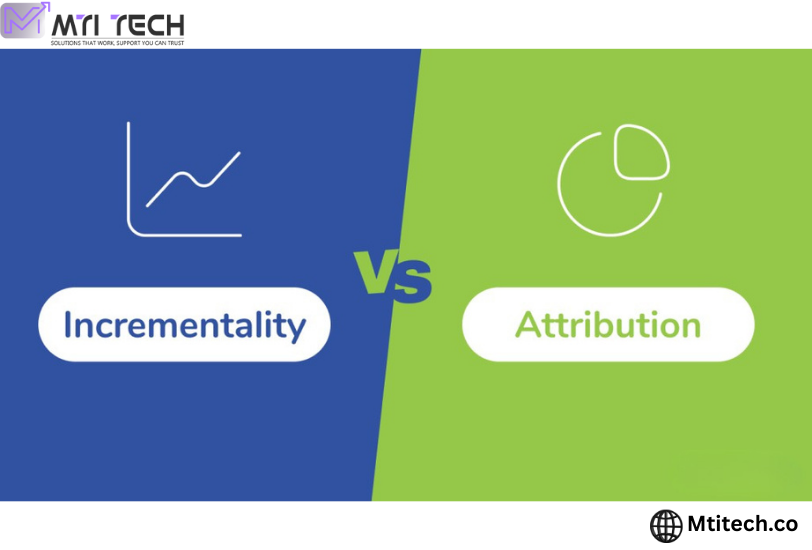
Attribution vs Incrementality (The Real Truth)
Attribution answers:
“Who touched the customer?”
Incrementality asks:
“Would the sale have happened without this channel?”
This distinction is critical.
Many channels capture demand rather than create it.
Without incrementality testing:
- Retargeting looks amazing
- Branded search looks essential
- Upper-funnel looks weak
But remove them, and sales don’t drop.
That’s the nightmare.
Why Attribution Fails in Real Life
Let’s list the structural problems:
1. Cookie Loss
- Privacy regulations
- Browser restrictions
- Shorter tracking windows
2. Cross-Device Behavior
- Mobile → Desktop → Tablet
- One user = multiple identities
3. Offline Influence
- Word of mouth
- Brand recall
- Sales calls
4. Long Buying Cycles
- B2B journeys can take months
- Attribution tools forget early touches
The Cost of Getting Attribution Wrong
Bad attribution leads to:
- Cutting profitable channels
- Scaling inefficient ads
- Over-optimizing for short-term wins
- Killing content too early
- Misjudging Digital Marketing Services ROI
In short: you grow slower and spend more.
How Smart Brands Handle the Attribution Nightmare
Instead of chasing a “perfect” model, smart brands do this:
1. Use Multiple Attribution Views
- Last-click for conversions
- First-click for discovery
- Linear for journey insight
No single model tells the whole story.
2. Group Channels by Funnel Stage
Instead of asking:
“Which channel won?”
Ask:
- Who creates awareness?
- Who educates?
- Who converts?
This mindset shift transforms Digital Marketing Services reporting.
3. Measure Assisted Conversions
Assisted conversions show:
- Which channels support sales
- Which ones nurture trust
Often, content and SEO dominate here.
4. Run Incrementality Tests
- Geo holdouts
- Channel pauses
- A/B budget tests
This reveals true impact, not just attribution credit.
Whiteboard Summary: The Right Way to Think About Attribution
If we were standing at a whiteboard, it would say:
- Attribution ≠ Truth
- No model is perfect
- Context beats precision
- Strategy beats dashboards
The goal of attribution is better decisions, not perfect numbers.
Attribution and Digital Marketing Services: The Strategic Connection
Modern Digital Marketing Services must:
- Educate clients on attribution limits
- Set realistic expectations
- Report holistically
- Align marketing with business goals
Agencies that blindly follow last-click metrics eventually lose trust.
Agencies that explain the nightmare become strategic partners.
Final Thoughts: Escaping the Attribution Nightmare
The attribution nightmare doesn’t end.
But it becomes manageable when you:
- Understand buyer behavior
- Accept imperfect data
- Focus on trends, not absolutes
- Measure growth, not ego metrics
Attribution is not about proving who “won.”
It’s about understanding how growth actually happens in multi-channel marketing.
Closing CTA
If your business is struggling to understand which channels truly drive growth, it may not be your campaigns, it may be your attribution framework.
Professional Digital Marketing Services don’t just run ads or publish content.
They connect the dots, align channels, and guide decisions with clarity, not confusion.